
For general maintenance and occasional steel grinding, aluminum oxide flap discs are a practical starting point. For repeated weld grinding and more demanding steel fabrication, zirconia alumina flap discs deserve a closer comparison.
The choice becomes clearer when you define the work: what material needs removing, how often the task is repeated, and what counts as an acceptable finish. Then compare complete disc specifications and test the candidates on that task.
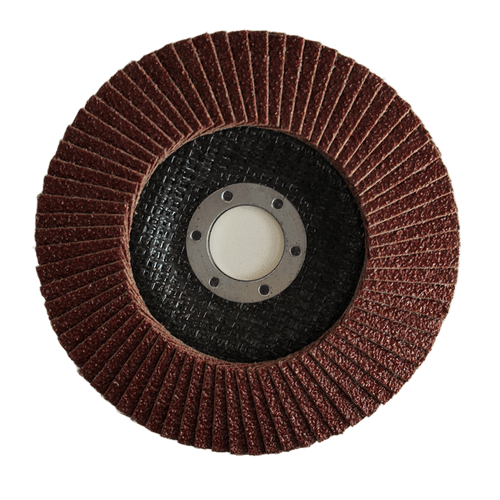 Aluminum oxide flap disc
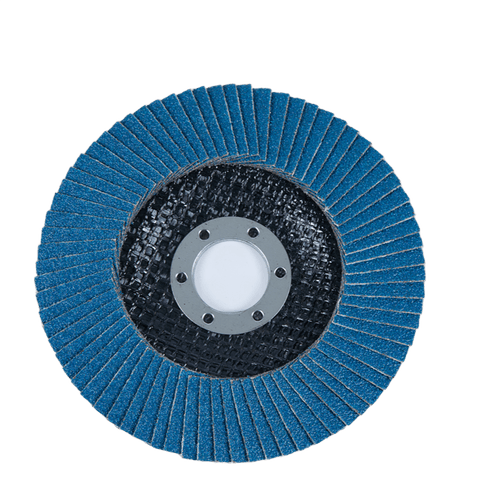 Zirconia flap disc
Aluminum Oxide vs. Zirconia at a Glance
“Zirconia” in this article means zirconia alumina abrasive. Aluminum oxide describes the abrasive grain; it does not automatically mean that a disc is suitable for aluminum workpieces.
| Selection question | Aluminum oxide | Zirconia alumina |
|---|---|---|
| Where should evaluation begin? | General-purpose grinding, maintenance and intermittent work | Repeated steel fabrication, weld grinding and demanding material removal |
| What should the trial establish? | Whether it completes the job efficiently enough at the required finish | Whether its results justify the quoted price for the workload |
| What could change the choice? | Frequent replacement, slow processing or additional finishing | Unsuitable operating conditions, an unacceptable finish or insufficient cost savings |
| What else must match? | Material suitability, grit, disc shape, backing, mounting and rated speed | |
These are sample-selection directions, not guaranteed performance rankings.
How the Abrasive Grain Affects Grinding
Abrasive grains remove material through their cutting edges. As those edges wear, cutting behavior changes. Conventional aluminum oxide grains dull during use. Zirconia alumina has self-sharpening characteristics: grain fracture can expose fresh cutting edges.
Self-sharpening does not mean a disc stays equally sharp indefinitely. Abrasive blends, cloth, coatings, flap arrangement and backing also contribute. Weiler’s flap disc guide discusses grain selection alongside construction variables. Compare specific products rather than treating the abrasive name as a complete specification.
Three Grinding Situations and Where to Start
The following are selection examples, not REX customer cases or test results.
1. Occasional Carbon Steel Deburring and Maintenance
Consider a workshop that periodically removes burrs or blends small areas on carbon steel parts. The work is intermittent, and a small difference in grinding time may have limited effect on the overall job cost.
An aluminum oxide disc is a reasonable candidate to evaluate first, provided the selected model is approved for the operation. Review REX aluminum oxide flap discs and confirm the specification for your application before requesting samples.
Check whether it removes the burr without excessive effort, preserves the required edge or contour, and leaves a suitable surface. If it meets those requirements, a higher-priced disc needs a measurable benefit to justify the additional cost.
2. Repeated Weld Grinding in Steel Fabrication
A fabricator processing similar welded steel components throughout a shift faces a different calculation. Grinding and changeover time accumulate across many parts. Zirconia is worth comparing because improvements in productive cutting or disc consumption have more opportunity to affect total cost.
Test it against the current disc on comparable welds. Record the time needed to reach the agreed contour, acceptable parts processed and disc consumption. A faster initial cut is insufficient if the product later requires more effort or creates additional finishing work.
Explore REX zirconia flap discs and confirm the specific model for your workpiece and grinding task.
Do not increase pressure simply to make zirconia “work.” Follow the operating conditions recommended for the specific product and machine.
3. Blending Where Surface Quality Controls Acceptance
When blending a joint while preserving the surrounding surface, controlled removal and an acceptable scratch pattern are the priorities. Grit, disc shape, flexibility and technique may materially affect the result.
Compare candidates against the same acceptance standard and include subsequent finishing time. Fast removal can still be expensive if it creates deeper scratches or extra rework. For stainless steel, confirm the selected product’s suitability and contamination requirements before testing.
Why the Same Grit Can Produce Different Results
The grit designation does not describe the whole disc. Products with the same marked grit may use different abrasive blends, cloth, coatings, flap arrangements or backings. They may contact the workpiece differently and produce different removal rates or surface results.
- Record the abrasive type and any disclosed blend.
- Check the grit designation and grading system.
- Match diameter, mounting, disc shape and backing as closely as practical.
- Record relevant coatings and construction differences.
If these features differ, the trial compares complete products; it cannot isolate the effect of grain alone. Confirm mounting and rated-speed compatibility with the machine before use.
How to Run a Useful Sample Comparison
Start with one question: Which disc completes this defined task at the lowest cost while meeting the acceptance standard?
Norton’s abrasive testing guidance describes comparisons using time, material removed and abrasive wear. Fixing one measure and recording the others helps make results meaningful.
Define the Task Before Testing
Select comparable workpieces and agree on the finished contour and surface condition. Record material grade, thickness and initial condition. Keep the machine, operator and procedure consistent while following each product’s instructions.
Define the stopping condition in advance. Do not use a disc beyond the manufacturer’s permitted condition to obtain a longer life figure.
| Trial field | What to record |
|---|---|
| Sample identification | Supplier, model, batch and complete specification |
| Workpiece and task | Material, dimensions, initial condition and defined operation |
| Acceptance standard | Contour, surface condition and inspection method |
| Processing time | Time to complete the agreed task |
| Consumption and changeover | Discs consumed and replacement time |
| Quality and rework | Acceptance, additional time and consumables |
| Observations | Loading, abnormal wear and other relevant behavior |
Repeat the comparison, alternate the testing order where practical, and retain the result range rather than only the best run. Photos can document visible surfaces, but they cannot establish roughness or temperature without appropriate measurement.
Compare Cost per Acceptable Part
A low unit price matters only if the disc completes the work economically. Use a consistent calculation:
Cost per acceptable part = (abrasive cost + processing and changeover labor + rework cost) ÷ number of acceptable parts
Add machine occupancy or scrap costs if material to the decision, and explain how they are counted. Longer life in minutes does not by itself demonstrate value: the disc must continue removing useful material and producing acceptable results.
What to Confirm When Sourcing From REX
REX’s specification sheet lists these dimensions for both aluminum oxide and zirconia flap discs:
- 100 × 16 mm
- 115 × 22 mm
- 125 × 22 mm
- 150 × 22 mm
- 180 × 22 mm
Dimensions are diameter × center hole. Listed grits are 36#, 40#, 60#, and 80#–120#. Confirm the specific required grit when requesting a quotation.
See REX flap disc specifications and applications for a broader overview. Before arranging samples, confirm the selected model’s application, disc shape, backing, mounting compatibility and rated speed.
For bulk and private-label inquiries, discuss labeling, packaging, batch identification and how subsequent orders will match the approved sample specification. Confirm sample availability, order quantity and delivery conditions for the inquiry.
Frequently Asked Questions
Is zirconia always better than aluminum oxide?
No. Zirconia is worth evaluating for demanding, repeated steel grinding, but it must deliver a useful benefit in the actual task. Aluminum oxide may be satisfactory for general or intermittent work.
Which should I consider for stainless steel?
Start with products specifically suitable for the stainless steel operation. Zirconia is a candidate, but grain type alone does not confirm suitability, contamination control or the required finish. Confirm the specific model and evaluate the result.
Should I choose by price or service life?
Use both as inputs, then compare cost per acceptable part. Include processing, disc changes and additional finishing. Service life matters only while the disc performs useful work.
What should I send when requesting samples?
Provide the workpiece material, task, grinder specifications, size, grit, target surface condition and estimated quantity. If replacing a product, include its specification and explain the problem you want to solve.
Ready to compare specifications? Contact REX with your application details to discuss a suitable product specification and sample availability before a bulk order.